B1 Speaking and Writing Practice: Fixing Mistakes with Root-Cause Explanations
At the B1 threshold, the main bottleneck shifts from knowing individual words to connecting ideas, choosing the right tense or case, and explaining reasons without translating word-for-word. The fastest way to turn corrections into usable language is to separate minor typos from structural errors, read a brief explanation of why the rule applies, and immediately rewrite or re-speak the sentence.
Note: The practice examples below are authored illustrations for this guide, not real learner transcripts or measured outcomes. For official level descriptors, see the Council of Europe's CEFR self-assessment grid.
What B1 actually demands in speaking and writing
According to the CEFR self-assessment grid, B1 learners can handle familiar matters at work, school, and leisure, describe experiences and events, and give brief reasons and explanations for opinions and plans. In practice, that requires three habits:
- Connecting clauses: Moving beyond two-word sentences by linking reasons and contrasts (because, although, so that).
- Keeping time frames consistent: Switching cleanly between past events, current routines, and future plans without dropping back to infinitives.
- Recovering when a word is missing: Paraphrasing or asking for clarification instead of stopping mid-sentence.
Why "corrected text" alone rarely sticks
When an app or chatbot simply rewrites your paragraph into polished native prose, two things go wrong:
- You cannot tell a typo from a grammar gap. Fixing a missing letter is very different from fixing a wrong verb tense or word order.
- Passive reading does not transfer. Reading a clean rewrite feels productive, but if you do not produce the corrected structure yourself right away, you will make the same mistake ten minutes later.
Effective B1 feedback should tell you which rule broke, why the correction works, and give you a chance to try again.
Worked example: turning one B1 mistake into a reusable pattern
Suppose the prompt asks you to explain why you changed your weekend plans.
- Attempt (authored example): "I stayed at home yesterday because it was rain, so I am cooking dinner for my friends."
- What actually matters here:
- it was rain → it was raining (or it rained): use the verb form for weather in progress, not the noun rain after was.
- so I am cooking → so I cooked: the story is set yesterday, so keep the result in the past simple to match stayed.
- Immediate retry with a changed detail: "I took the bus this morning because it was raining, so I arrived on time."
Notice that repeating the exact same sentence is less useful than keeping the corrected pattern (because it was raining, so I [past tense]) and swapping the situation.
What this looks like in an exercise
In Edyssey, writing challenges evaluate your answer with typo tolerance, explain the underlying grammar or word-choice issue inline, and keep a Retry button right below the feedback so you can apply the explanation immediately:
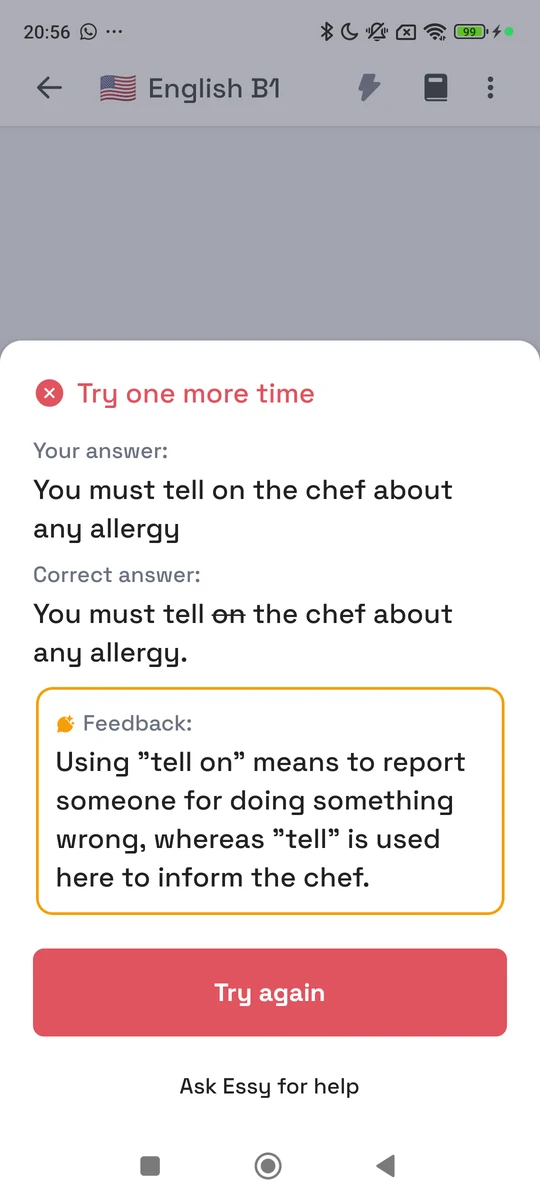
Captured Android app screen showing a B1 English writing attempt, correction, explanation, and retry button. This illustrates the feedback format on a single attempt, not a measured learning outcome.
A 15-minute B1 speaking and writing routine
Pairing writing and speaking on the same topic lets you catch structural mistakes in writing first, then build speed in speech:
- Write without a dictionary (5 minutes). Answer one B1 prompt in 3–4 sentences—for example, describing a recent trip, explaining a hobby, or comparing two options.
- Fix one recurring pattern (3 minutes). Check the feedback. Pick one structural rule (such as tense consistency, prepositions, or case endings) and write one new sentence using that same rule.
- Speak on the same topic without looking (7 minutes). Put your written text away and answer a related follow-up question out loud. Focus on using the pattern you just fixed without pausing to translate.
Practising B1 speaking and writing in Edyssey
If you want structured B1 practice with explanations built in, Edyssey combines:
- Adaptive CEFR placement (5–8 items): If you are unsure whether to start at A2 or B1, a tap-only placement quiz (no microphone required) recommends a starting level that you can accept or override.
- Typo-tolerant writing evaluation: Minor spelling slips do not block progress, while grammar and meaning errors get inline root-cause explanations and a retry option.
- Mistake-pattern tracking: Recurring error patterns across exercises feed into future generated lessons and tutor prompts, alongside spaced-repetition vocabulary review and an activity feed where you can redo past exercises.
- Real keyboard or mobile voice: Type longer B1 answers comfortably on a desktop or laptop browser at edyssey.app/learn (with Google sign-in), or switch to your phone for live voice speaking practice.
See Edyssey's Android and iOS download options or open the browser app. AI features require an internet connection and voice practice requires microphone permission. Generated exercises and explanations can vary and can contain mistakes; Edyssey is an independent learning app, not an official exam provider or certification service.